MOME
2024
IST-ONE: István Bányai exhibition design
Visual identity and graphic system for a retrospective exhibition on the work of illustrator István Bányai, at Moholy-Nagy University of Art and Design

Special thanks for
Katalin Bakos, Katalin Bányai, Simon Bányai, Sára Bárdi, Eszter Földi, László Herbszt, Ilona Jobbágy, György Kara, Tibor Kárpáti, Attila Lőrincz, Tamás Marcell, Gyula Molnár, László Nagy, István Orosz, Attila Simon, Zsolt Zimmermann, László Zsótér, Hungarian National Gallery, Nfi
Exhibition documentation photos
Máté Lakos
Overview
It was a great honor that my former university, MOME, asked me to design the graphics for the retrospective exhibition of István Bányai.
István Bányai was a leading figure of the Hungarian graphic design generation of the seventies, and one of the best known, internationally recognized illustrators of the College of Applied Arts, the predecessor of MOME. Early in his career he designed film posters, record covers and book illustrations in Hungary, then emigrated to the United States in the eighties, where he worked until his death. His illustrations appeared for years in magazines such as The New Yorker, the Atlantic Monthly, New York Magazine and Playboy. His 1995 book Zoom became a milestone of the wordless picture book.
Bányai passed away at the end of 2022, and would have turned seventy five in 2024. His alma mater, MOME, organized the retrospective exhibition on this occasion. Following the curatorial concept, the exhibition did not only present the works, it was built around questions that concern students and professionals today. How other artists and educators tshape the style of a designer, what it is like to work abroad as a Hungarian, and how drawing can shape public opinion.

Istvan Banyai, Set in Stone. The New Yorker, October 13, 2008

Istvan Banyai, Mouse Trap Lawyers and Gamers Cheating. The Economist 2019
My role
We developed the visual concept of the exhibition together with curator Noémi Viski, and the installation elements with Dóra Katona.
From the graphic concept to the final execution I was responsible for the entire visual appearance of the exhibition. The work covered the design of the exhibition wall, the exhibition surfaces and the title and label system, as well as print materials such as posters and leaflets, and the graphic design of the social media surfaces.


Challenges
The scale of the space and the wall
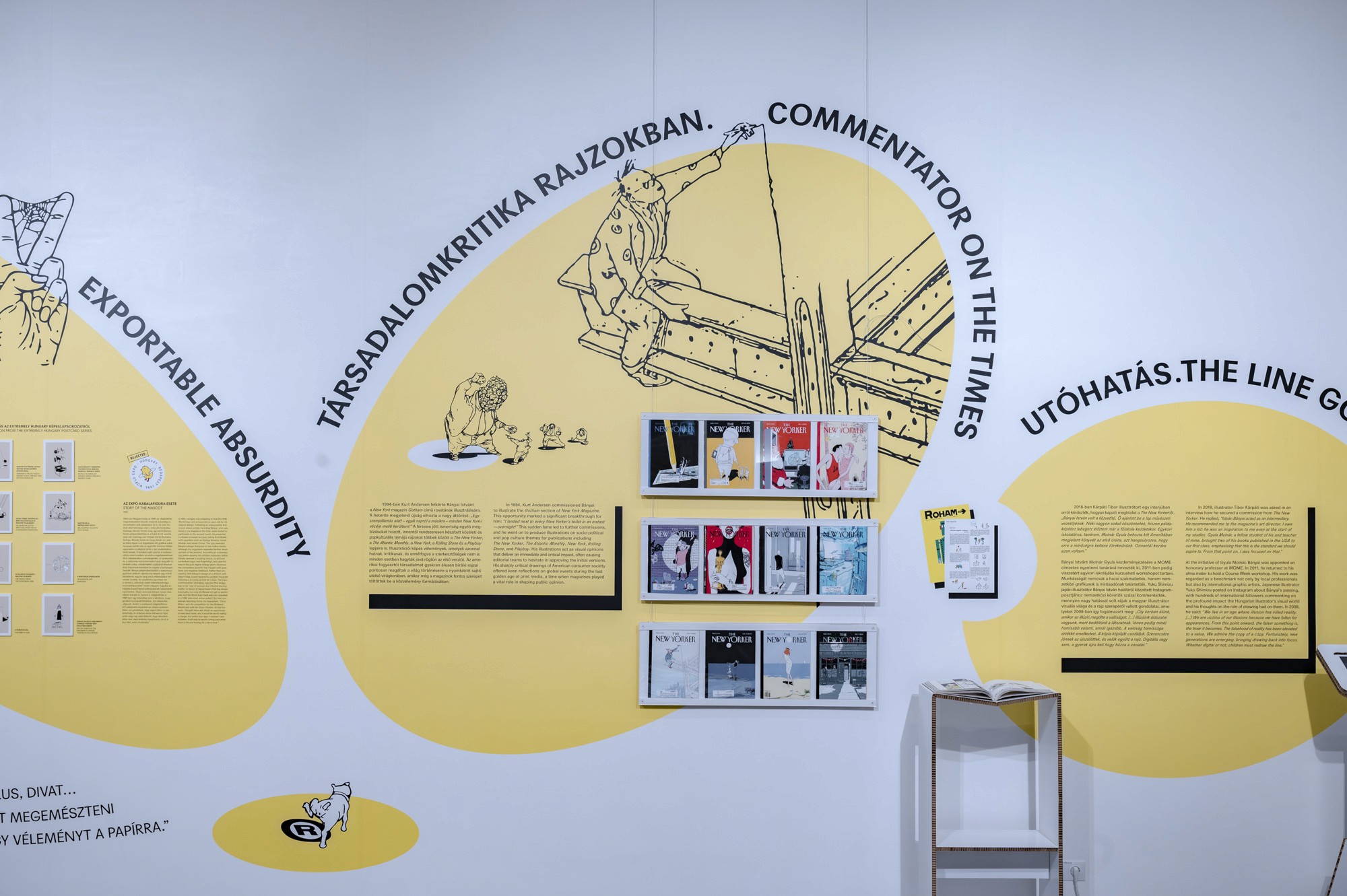
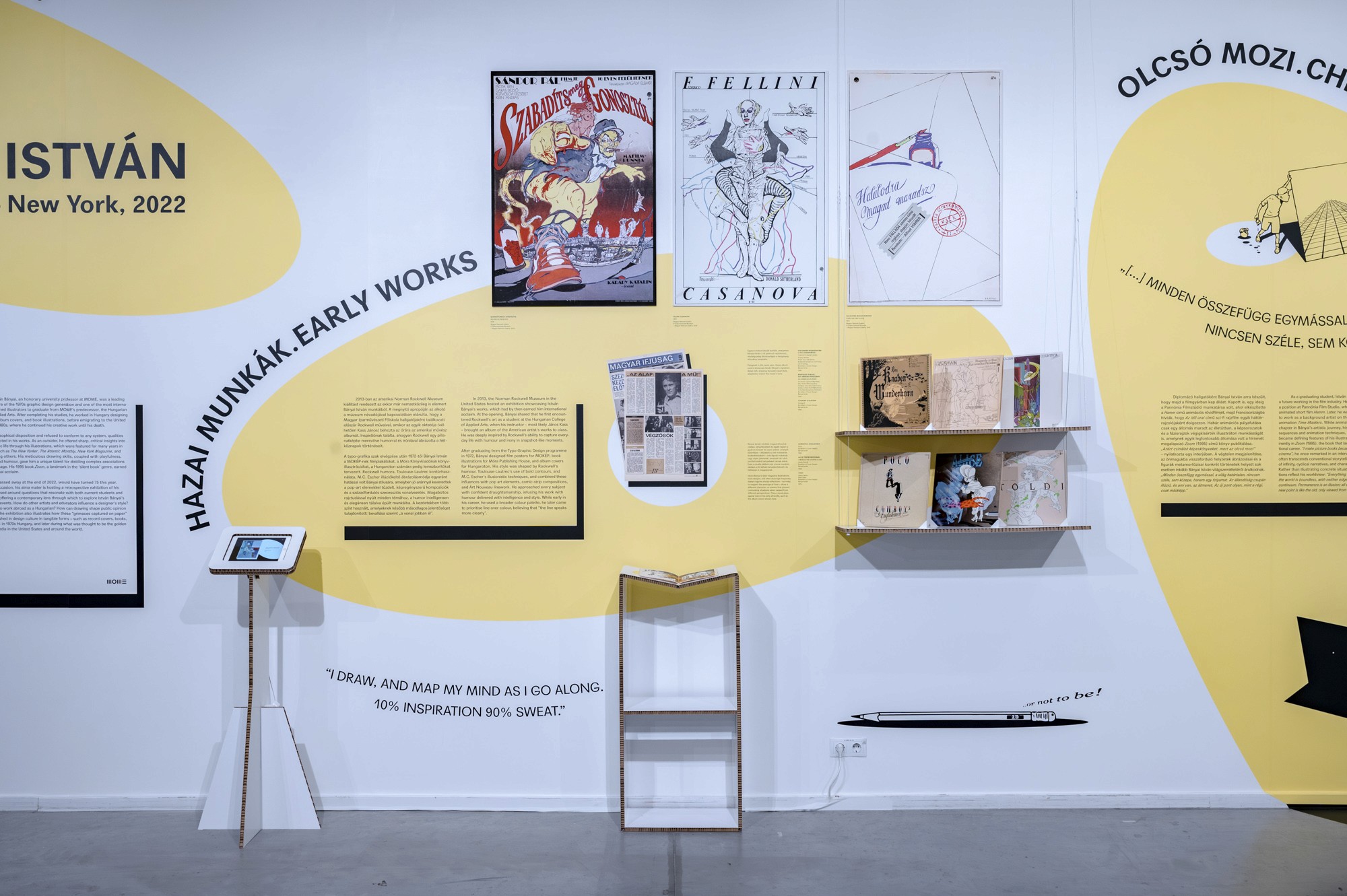
The dedicated space at MOME Ground works as a passage, a corridor of sorts, and we had to think accordingly. The exhibition wall was 17 meters long with a ceiling height of 5 meters, which was a considerable scale in itself. We needed a solution that reads as one coherent image from a distance, while the labels stay easy to read up close. Another constraint was that we could neither paint nor drill into the wall, so every element had to be either hung or applied as vinyl.

An identity that highlights Bányai's work instead of competing with it
I had to design a visual system alongside a strong body of illustration work with a character of its own. Something that gives a frame and holds the material together, without turning into a rigid system that would suppress the freedom of Bányai's thinking.

Identifying Bányai's visual and logical motifs
We had to work through the body of work and find the recurring motifs that could serve as a basis for the graphic concept.
A consistent, extendable system
The concept had to be adaptable to every exhibition surface, from the pedestals through the label system to the displays, and it also had to work in digital space, for example on social media.


Key solutions
Translating Bányai's philosophy of drawing
The visual concept started from the mapmaking quality of Bányai's work and his philosophy of drawing, from the idea that a drawing can map human thinking and states of mind. Bányai's illustrations often feature a spotlight like, sharp light playing with circles and lines. This became one of the main motifs of the identity, putting his works quite literally in the spotlight.
A mind map across the wall
The exhibition as a whole was built as a drawn, mind map like system, as if Bányai had filled the wall of MOME Ground himself. Detailed vectorization of his drawings made this possible.

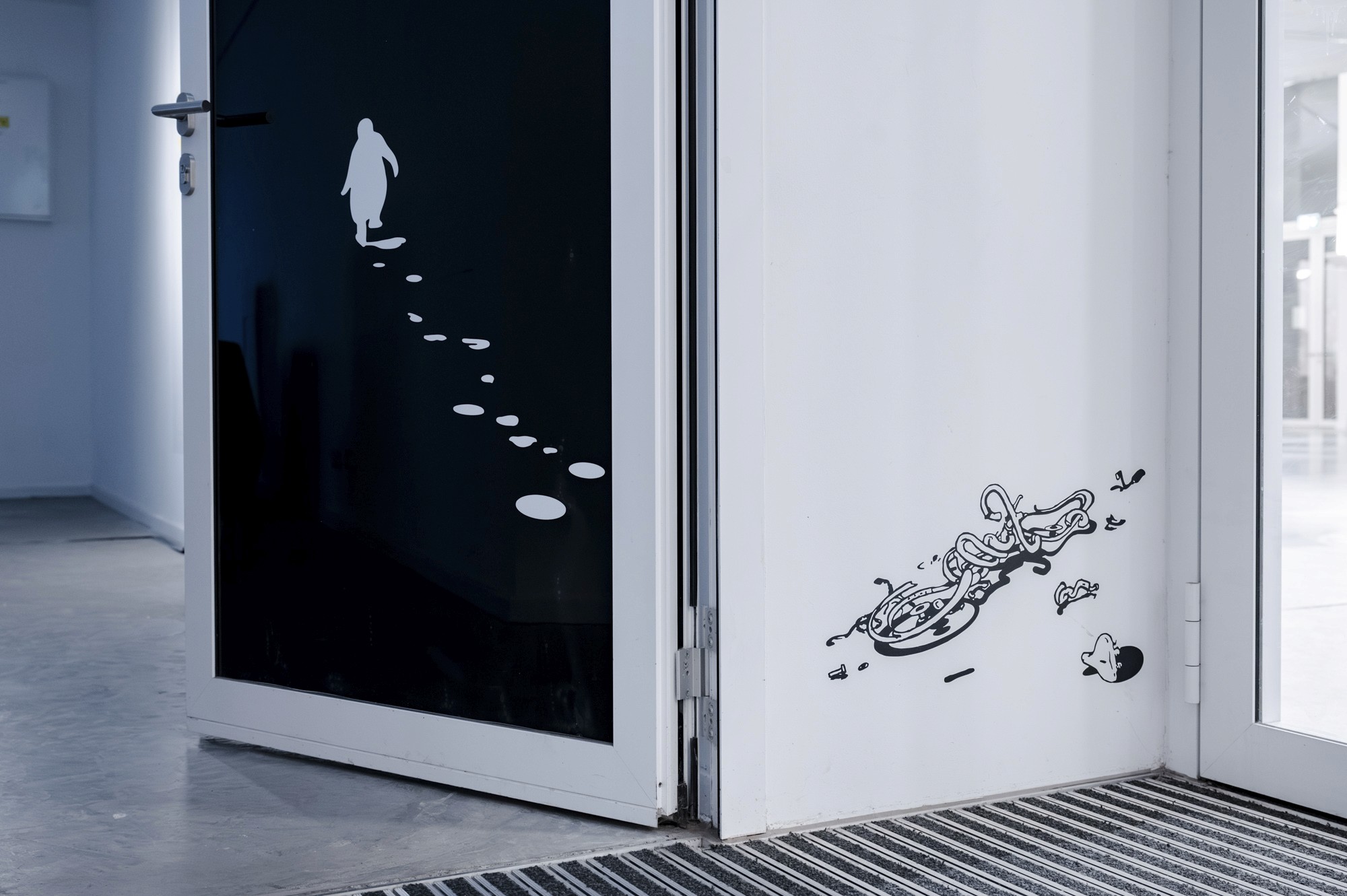
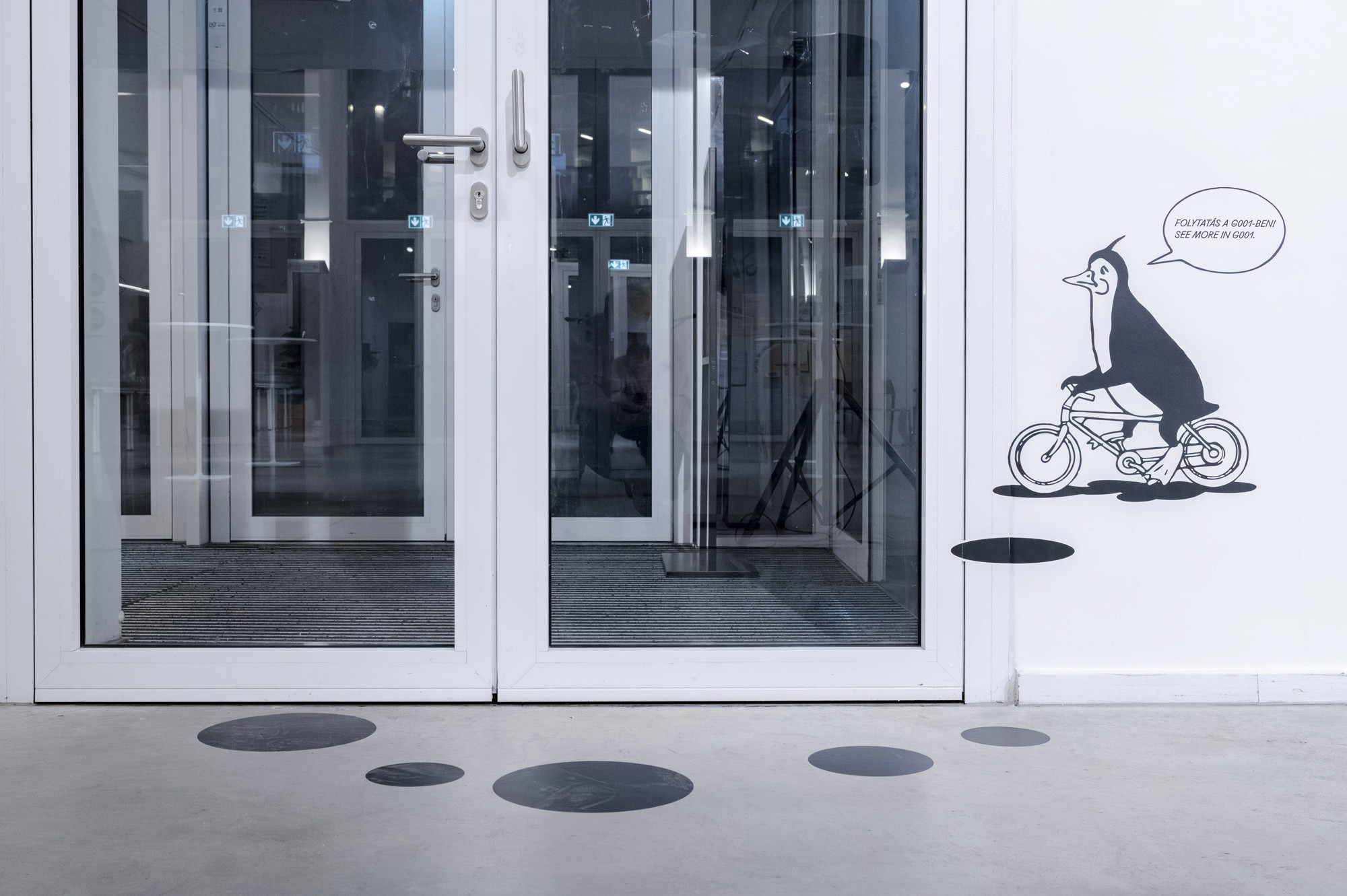
Illustrations hidden in the space
Bányai illustrations were tucked away at several points of the exhibition as small discoveries. They served a double purpose, they connected the main exhibition space with the video room, and they drew in visitors arriving through the different entrances.


Honeycomb cardboard, reusable installation elements
Instead of traditional museum pedestals, the installation elements were made of honeycomb cardboard. This is a more sustainable solution, and it also suited Bányai's fast, paper based drawings better.
A round podium with illustrations to take home
We designed a circular pedestal where pages of magazines and newspapers illustrated by Bányai lay as if they had been scattered around. We printed these pages physically as well, so visitors could take one home as a keepsake.
Interactive tablet interfaces
Two interactive tablet interfaces completed the exhibition, at the opening and the closing station, where visitors could explore the work of related artists.