Museum of Ethnography
2023-2026
Designing the Jelenarchívum platform
Designing the full responsive interface of a community photo and story archive

Overview
The Museum of Ethnography asked us to design the digital platform of Jelenarchívum. The project runs within the museum's MaDok program, and its goal is to collect, organize and archive photographs and personal stories from the recent past, from the 1990s to the present day.
For the museum the archive is a way to document how people use photography today, and it also enriches the museum's contemporary collection. What makes the archive meaningful is that it gives room to the photograph and the story behind it together, and puts the emphasis on personal storytelling.
Our goal with the platform was to create a user experience that supports sharing your own photo and the personal story that belongs to it, while it also helps visitors discover the photos and stories that are already there.
My role
As product designer I was responsible for the project from research and concept creation all the way to the full UX/UI implementation. I worked closely with a colleague at Virgo, with the client side project owners, a legal expert and the developer.
Design and development ran in parallel, in an iterative process, so we held continuous internal meetings and demos with the developer to surface feasibility questions while the design was still in progress.

Challenges
Reaching a wide audience
Jelenarchívum had to reflect the openness and community focused thinking of the museum. We had to design an interface that works regardless of the visitor's age or digital skills.
Connecting two archives (Fortepan)
The project was carried out together with Fortepan. Fortepan is a freely usable community photo archive covering the period between 1900 and 1990, and Jelenarchívum continues where it ends. We had to make sure the two collections stay continuous in time and in content.
Long term extensibility
The archive is organized around thematic collection campaigns. We had to build a content and technical framework that can handle photo and story collections for very different research topics, without rethinking the structure of the interface every time.
Photos of varying quality
People upload very different material. The platform had to handle photographs of different resolutions, aspect ratios and quality, as well as stories that range from a few sentences to long texts. Keeping longer texts readable on both mobile and desktop was a key consideration.
Legal terms inside the flow
Handling copyright and usage rights was an important part of the project. We had to build this into the upload flow in a way that stays clear and transparent without breaking the user experience.
Multi-step publishing flow
One of the biggest challenges was the multi-step publishing flow. Users can first save their stories and photos as drafts, then submit them for approval. Administrators handle these submissions on a separate interface and decide about publishing. This flow had to be grounded from a UX point of view as well.

Design solution
1. Research and discovery
Benchmark and best practice analysis
We reviewed similar Hungarian and international platforms specialized in photo archives or community storytelling. This gave us the functional solutions that served as reference points for designing Jelenarchívum.
Stakeholder interviews
Through interviews we mapped the expectations of the museum and of the users, and how the archive fits into the museum's existing collection work.
Information architecture and sitemap
Based on the research findings I built the information architecture and the sitemap of Jelenarchívum. I defined the content levels, the navigation links between them, and which paths are available to logged in and logged out users.
2. Concept creation
When shaping the concept I had to create a look that fits the existing visual identity of the Museum of Ethnography, while the interface also works as a standalone, inviting entry point.
3. UX/UI design
I was responsible for the responsive design of the full interface. The work covered the following areas.
User account
Registration and log in
Multi step photo and story upload
Logged in user interface for managing your own submissions and following their status
Discovery and browsing
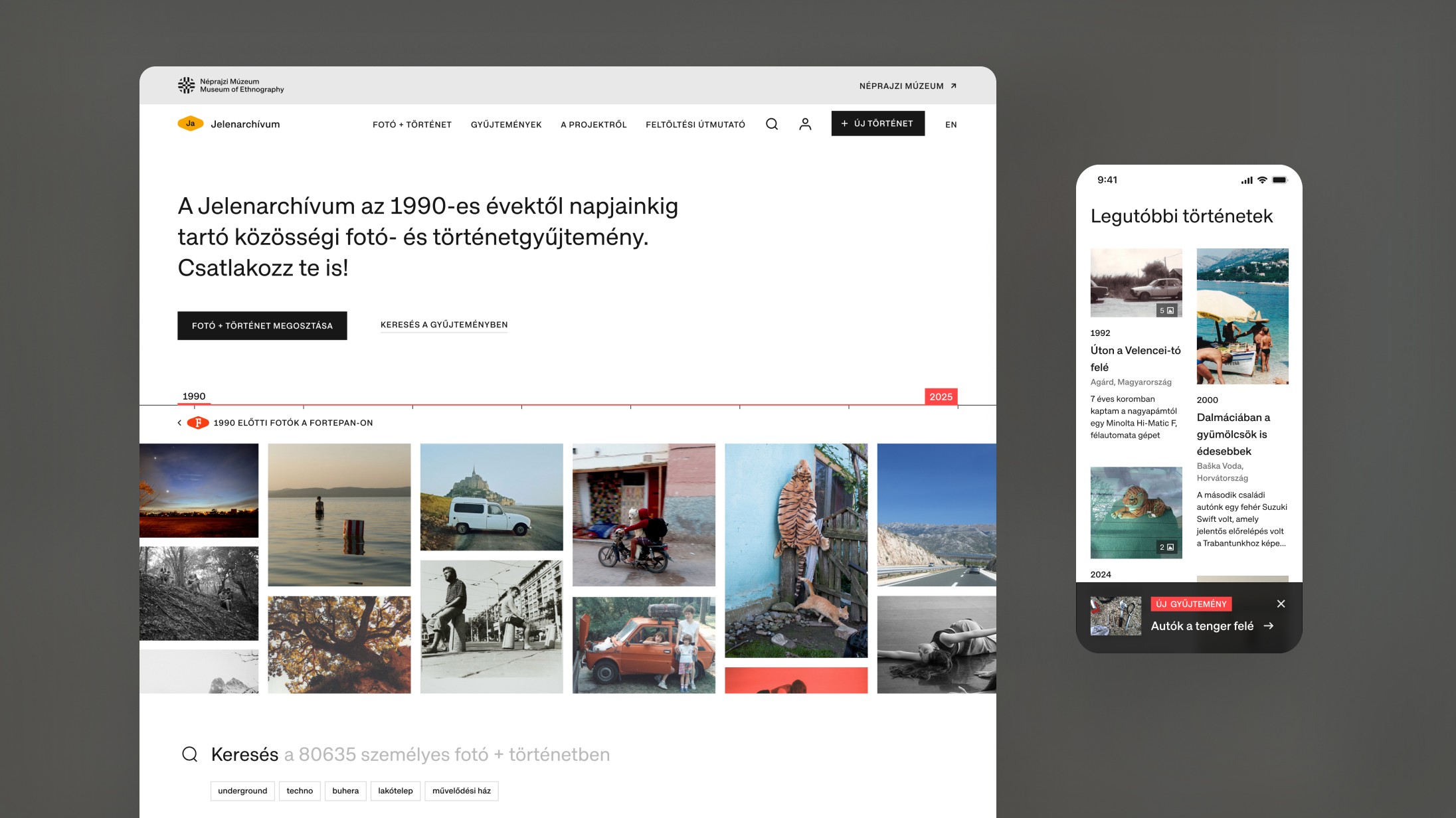
Homepage as an entry point, with featured collections, latest stories and search
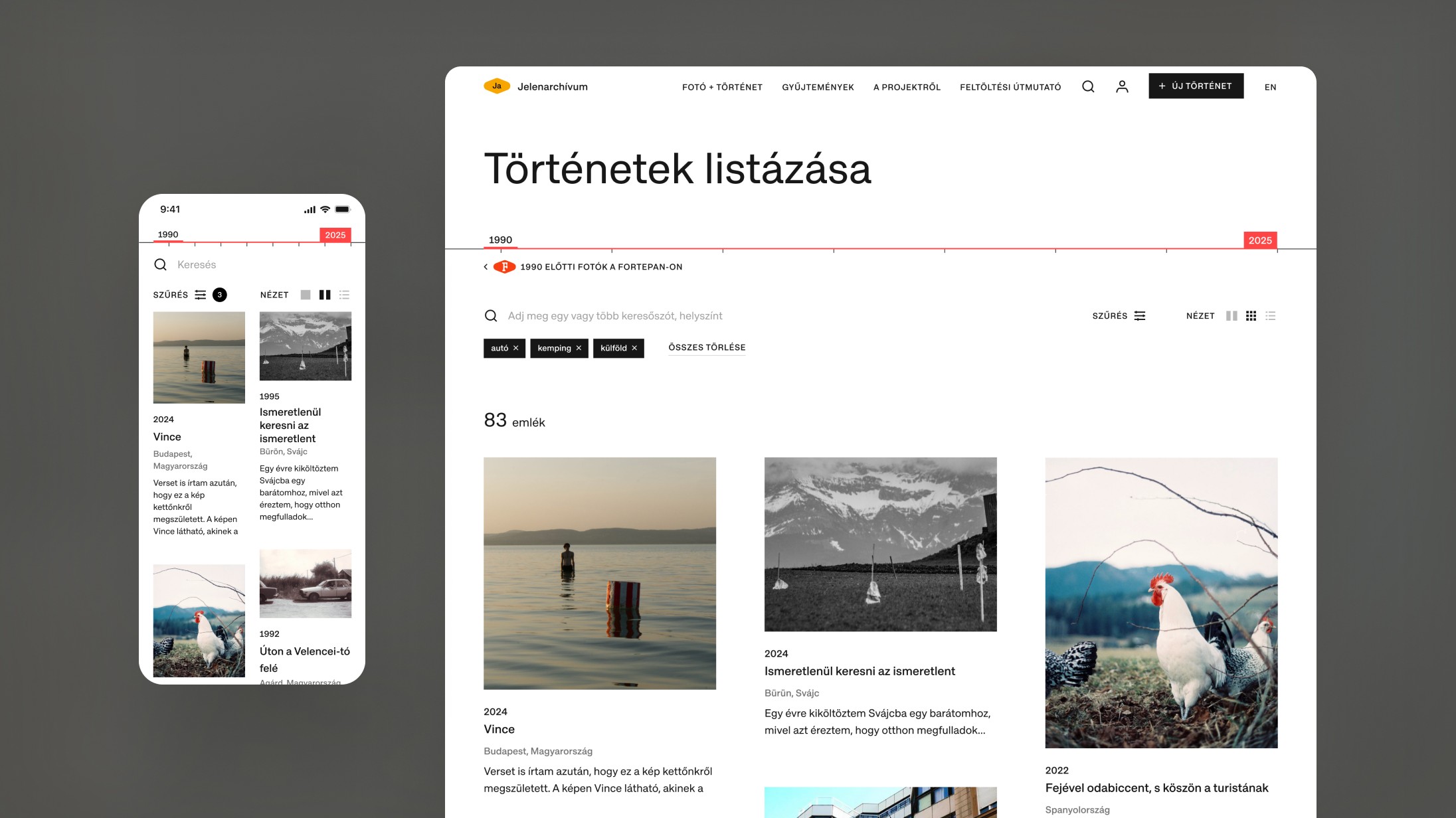
List page and detail page for photos and stories
Keyword search and tag based filtering
Timeline and logical navigation between content
Collections list page and separate pages for the running campaigns
Content pages
Blog for news, open calls and related events
Project page and presentation of the research partners


5. Design system and UI animations
For the visual design of the interface it was important to fit the existing identity of the Museum of Ethnography. When designing the UI elements we started from the look of the museum's digital platforms.
Results
Jelenarchívum launched successfully and generated active community participation right from the start. Several thematic collections are running on the platform, and users have already shared more than 740 photographs along with the personal stories behind them. The result was built on close collaboration with the Museum of Ethnography and the development team, present from the initial concept work through to implementation.